AI Strategy for CDOs & CPOs: Better Business Decisions
Any product team can move at speed today - generating summaries of user research during the user interviews, build journey maps whilst the workshop is in progress.
That is useful. It gives teams more room to explore, compare, iterate and learn. It reduces some of the manual weight that has traditionally sat around research, design, service design and product strategy.
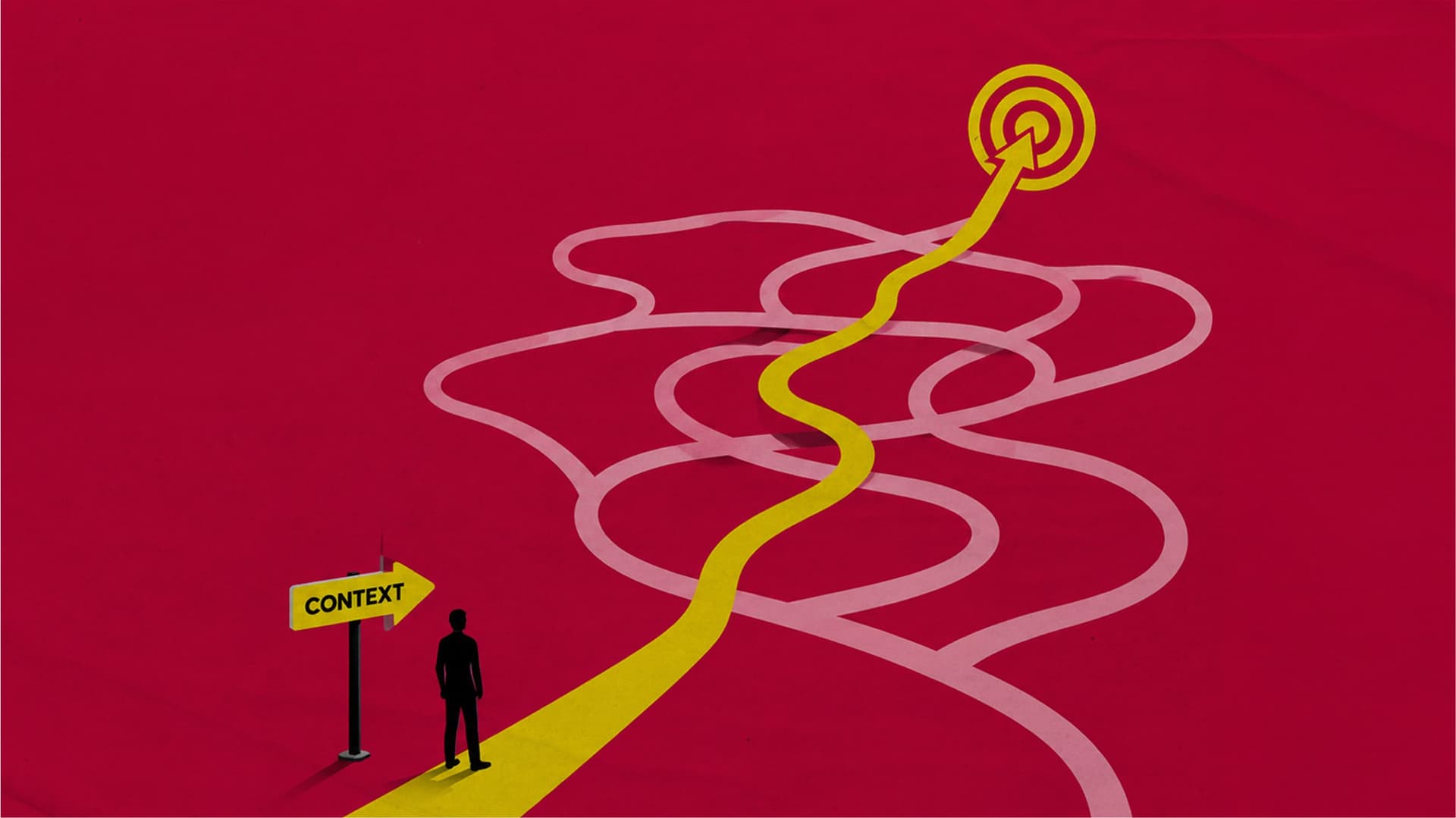
But it also creates a new challenge: the output can arrive faster than the judgement around it. For me, this is the important shift: AI has changed the context, not the purpose.
The fundamental work remains the same: discover problems, solve them the right way, and continuously improve. AI can help us move faster through evidence, ideas, patterns and outputs. But it does not automatically tell us which problems are worth solving, which signals matter or what an organisation should do next.
This is why the conversation needs to move beyond individual AI tasks and towards the problems those tasks are meant to support.
From task-level AI to business-problem-level AI
A lot of AI adoption still starts at task level.
Help me summarise this.
Draft that.
Cluster this feedback.
Generate a journey map.
Write a prompt.
Create a set of ideas.
There is value in that. Used well, AI can help create a first pass quickly. It can compare inputs, identify patterns, structure ambiguity and generate alternative ways of framing a problem.
But task-level use alone will not unlock the bigger value. The real value comes from what happens around the output: questioning it, testing it, refining it and deciding what it means.
The bigger opportunity is moving from task-level AI use to business-problem-level AI use. That means asking where AI should be applied in the first place, how AI outputs connect to decisions and where human judgement still matters.
In practice: accelerating ideas to concepts
We saw this play out on a recent programme with a private bank developing its commercial banking proposition. The business problem was not "generate more concepts". It was understanding how to better engage prospective commercial clients and support their progression towards enquiry. AI was used as a concept engine. It expanded early ideas, drafted page copy and produced storyboards at a pace that would previously have taken weeks; 43 storyboards in a matter of days.
But the value was never in the 43. It was in the human context brought to them.
A storyboard on its own is a proposition in isolation. The questions that mattered sat around it. Where does this sit in the wider customer experience, before and after the moment it depicts? And which of these concepts actually move the things the business is measured on; enquiry volume, enquiry quality, progression towards conversion rather than simply being interesting?
That framing is what turned a pile of concepts into a shortlist worth testing. What the team walked away with was not 11 concepts. It was a prioritised view of where to invest in the commercial pages and the enquiry journey, grounded in evidence strong enough to defend in a roadmap conversation. Seven weeks, start to finish.
That example is still a relatively contained problem: one journey, one part of the proposition. Most are not. Real business problems are rarely contained within one screen, one journey, one campaign or one team.
They cut across departments, functions, stakeholders and ways of working. They are shaped by what the organisation is trying to achieve, which outcomes matter most, where decisions are made and who owns which part of the problem.
Once the lens widens to business problems, context becomes the critical layer.
The missing layer is organisational context
One of the biggest limitations to keep in view is context.
AI can process information, but it does not naturally understand the messy reality of how an organisation works: decision flows, knowledge flows, human systems, trust boundaries, informal ways of working, what is documented versus what actually happens and where context breaks down between teams.
Most organisations have formal processes and technology systems that are written down somewhere. But how people really work is often more fluid. It is relational, political, dependent on trust, shaped by history and constantly changing.
That context matters because it determines whether an idea can actually be acted on.
AI may help generate a journey map from customer feedback. But deciding whether the issue is a content problem, a service ownership problem, a governance problem, a technology constraint or a product strategy problem still requires judgement.
In practice: reimagining a change and release workflow
A wealth management division of a global financial services firm wanted to modernise its change and release management lifecycle. The symptoms were manual hand-offs, fragmented governance and inconsistent workflows — and, tellingly, those same conditions were limiting the adoption of AI across its engineering teams. The blocker was organisational, not technological.
None of that sits inside one team or one system. So the work started by mapping the end-to-end release lifecycle across people, processes and technology, alongside engineering, release management and governance teams. That mapping is what showed where AI could realistically be applied rather than theoretically applied.
Generating candidate AI opportunities was the easy part. Knowing which ones the organisation could actually absorb, in what order, and what had to change around them — that was the work.
This is where human expertise becomes more important, not as a final check after AI has done the work, but as the layer that gives the work direction.
The role of expertise is to make AI outputs decision-ready
Human expertise adds value by bringing the consulting layer around AI-enabled work. The critical capability is understanding how people, systems, technology and incentives interact across an organisation.
That means helping teams move from:
“AI made something.” to: “We know what this means, what decision it supports, and what needs to change.” In practice, that means asking better questions around AI-enabled outputs.
What is the evidence actually saying?
What might be missing?
Where are we seeing a real pattern and where are we seeing noise?
What does this mean for customers?
What does this mean for the business?
What can the organisation realistically change?
What decision does this need to support?
How does this feed into the product roadmap?
How does this fit into the organisation’s current ways of working and strategy?
These questions are not secondary to the work. They are part of the work. In both the examples above, they are the questions that turned volume into direction: which concepts were worth taking forward in one case and which workflow changes to sequence first in the other.
Point of view
AI is changing the pace of experience work. That pace is valuable, but only when it is matched with judgement and linked to strategic implication. For me, the role of AI is to help teams explore more, see patterns sooner and reduce the drag around production and implementation.
The role of human expertise is to decide what those patterns mean, how much confidence to place in them, where the gaps are and what should happen next from a product, service and strategy perspective.
The first example shows what pace looks like when it is paired with validation. The second shows what happens when you start with organisational context rather than with the tooling. Different problems, same principle.
In an AI-enabled world, the value is not simply in creating more answers. It is in knowing which answers matter, what they mean, and what an organisation should do next.